Queer story of 'Carmilla' by Sheridan Le Fanu
‘Carmilla’, a gothic novel by Irish Sheridan Le Fanu published in 1872, is the first book published in the English literature history whose main character is female vampire. Furthermore, it’s one of the most influential works about the homoerotic relationship between two women. That’s why ‘Carmilla’ became that valid in the LGBTQ+ community. Innovative and queer ‘Carmilla’ inspired also the most famous vampire novel, ‘Dracula’, published 25 years later by Bram Stoker.
Vampirism represented in Victorian literature all the anxieties of the contemporary elites, everything that was disturbing and disgusting for them. Non-heteronormativity, liberated women, sex for pleasure, not only reproduction, lower classes, the nonbinary, people of colour. A vampire was for the Victorian upper-class metaphor of the unknown, unwanted, uncontrolled. That’s the reason why Le Fanu chose this exact motif to illustrate romantic and erotic lesbian relationship and also to portray the liberated woman, Carmilla, in his work.
‘Carmilla’ tells the story of the titular vampire and her closest friend, Laura, whose relationship is clearly marked as romantic. Carmilla drinks Laura’s blood, and this act of a bite is undoubtedly connected to desire and sexual act. Although in original Slavic believes, which were the beginning of the vampire race, these creatures were so inept, similar to the common view on zombies. Nevertheless, today vampire is associated with eroticism.
———• ☾ •———
Why is vampirism eroticised?
Vampires exist in human culture since ancient times. Although the modern image of vampires like the ethymology of the term 'vampire' comes from Eastern and Southeastern Europe, vampire-like creatures had existed much earlier than in Slavic cultures. From Greek Lamia1 and Ewe adze2 to Aztec Cihuateteo3, the myth of blood-sucking creatures is spread all over the mythologies of the whole world. This myth exists even in modern times, for instance in the urban legend of chupacabra4. The modern vampire is associated with beauty and hypnotising eroticism. It can easly be seen in young adult literature ('Twilight', 'The Vampire Diaries', 'The Mortal Insturments') whose vampire characters are a object of human sexual urge.
Lilith and Carmilla
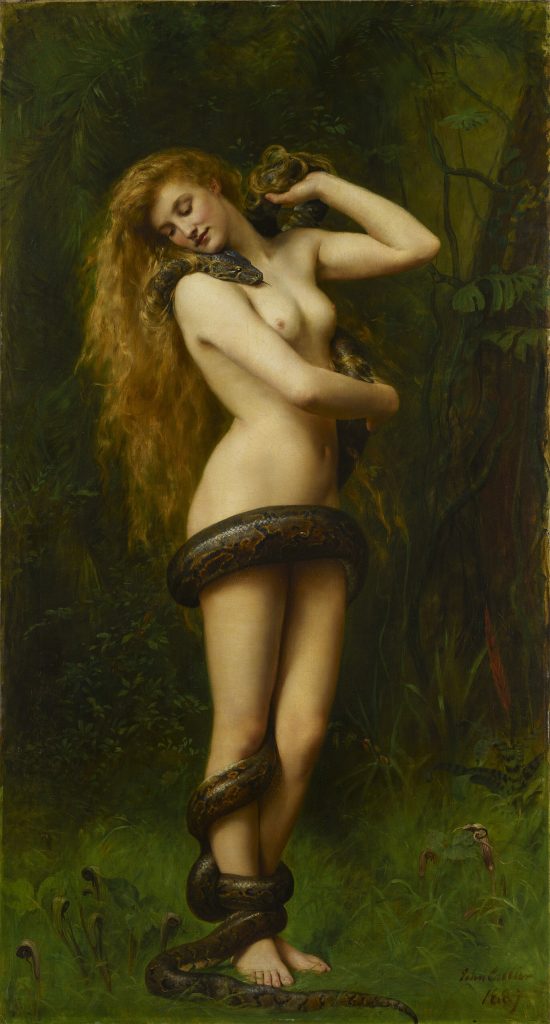
The first ever vampiric creature associated with sexual desire was Lilith, originating in Babylonic mythology demoness from Jewish mythology. She is considered to be the first and original wife of Adam who has been banished from Eden for disobeying to Adam. Then, her place has been taken by Eve, the second and submissive wife. Lilith is translated as a 'night monster' and in Middle Ages her name started to be associated with Asmodeus, King of Demons. Lilith in Kabbalah is sometimes thought to be a female Leviathan which is a Biblical sea monster and a symbol of evil. Some even believe that Lilith was a serpent that made Eve try a fruit of The Tree of Knowledge.
The main reason why Lilith is considered to be a proto vampire is her tendency to suck a young men's vitality and to kidnap children. It links Lilith to posterior Slavic vampires that were a form of vampires we know today. Most importantly, Lilith is a femme fatale - a dangerous seductress that dominates men with her sexuality. She perfectly relates to the modern form of vampires and she propably has been their origin. Titular Carmilla from Gothic novella is an Irish avatar of Lilith being a forbidden fruit, both dangerous and sexy.
The Symbolism of Sucking Blood
Redness of blood of course connect it with red as the symbol of desire. Vitality, passion, impetousness - red of blood symbolises it all. Blood is generally symbol of life and fertility whose fullest form is ardour. What is intriguing, for a long time sucking blood has been being a form of creating an intimacy and a bond. That's the biggest reason why vampires are depicted as such sexualised creatures. As I said, it is perfectly seen in 'Carmilla' whose titular character vamps Laura, her friend with hypnotising manner. In 'Dracula', female vampires are shown as amorous and flirting. Propably due to the Lilith origins, mosly female vampires are that eroticised but in modern works, males are starting to gain popularity like Edward ('Twilight') or the Salvatore brothers ('The Vampire Diaries').
———• ☾ •———
Irony of the Reception of Lesbian Relationship in the Conservative Societies
The interactions between Carmilla and Laura alone are deeply sensual and steamy. Carmilla feels even obsessive towards Laura, she’s unhealthily attached to Laura, and that’s so goes beyond the platonic friendship. If this evidence weren’t enough for you, the illustrations in the numerous editions of ‘Carmilla’ suggest the non-platonic relationship between the two main characters.
In 19th-century Great Britain that close relationships between two women weren’t seen as romantic, thus Le Fanu could have added to his work so controversial content. These platonic bonds that were seen in the female relationships mainly were the consequence of the asexual and innocent ideal of Victorian woman.
Thus, in both conservative the 19th-century England and the Franco’s regime in Spain, ‘Carmilla’ were printed without problems. What’s interesting, ‘Carmilla’ was printed in both of these two historical realities with the mentioned suggestive illustrations, what highlights how a close relationship of two women wasn’t then interpreted as romantic. Interestingly enough, probably as a consequence of the increasing consciousness of the existence of non-heteronormative relationships, in 2025 the regime of Belarus marked ‘Carmilla’ as a banned book, justifying this act as preventing a ‘danger of the national interests of Belarus’.
Controversies around 'Carmilla'
However, the intentions of the author himself in the presenting Laura and Carmilla’s dynamics are interpreted dualistically. Firstly, ‘Carmilla’ is a very bold and innovative novel, presenting all the banned aspects of Victorian society. However, on the other hand, this specific representation of homoeroticism might also have homophobic connotations.
Vampirism, representing for instance the non-heteronormative relationships, is shown in ‘Carmilla’ as a disease (just like almost all works with the vampirism motif included do, by the way). Laura literally weakens physically from the Carmilla’s bites, Laura fades as the plot continues. This condition doesn’t stop even when Laura and Carmilla are separated. Laura still thinks about her former friend/lover, which is very similar to a disease setback. Thus, it may be considered that presenting the homoerotic relationship this way, Le Fanu wanted to demonise lesbian love.
This interpretation may be deepened by the fact that the character building of Laura and Carmilla are created based on two contrasting images of a Victorian woman. Laura is the ideal woman of this historic period, beautiful, vulnerable, delicate, innocent, asexual. She’s a Victorian ‘angel in the house5’, id est the wanted image of femineity from this epoque. It considered women’s natural habitat a house and nurturing a family, in contrast to men, who were to work, work in politics and the public sphere as a whole.
It contrasts with the character construction of Carmilla. She is sexually liberated, passionate, overwhelming. She opposes patriarchy, dominates the men in the novel with her character and actions. She’s thus a woman feared by Victorian society. Carmilla is a character that may be interpreted as a warning and anti-role model for the readers, contrasting with the ‘perfect’ image of Laura.
Impact of 'Carmilla' on Queer Community
Although it isn’t unequivocal, what the intentions of Sheridan Le Fanu was, his work affected deeply the pop culture and the LGBTQ+ community thanks to the readers, who has created Carmilla as a queer icon. So, no matter what the original purpose of ‘Carmilla’ was and how this book was to be interpreted, at the end of the day ‘Carmilla’ is both a queer classic and the precursor in the vampire horror field.
Literature:
1. 'The Dark Side of British Horror Fiction: Politics, Taboos and Censorship' by Alberto Lázaro, University of Alcalá, 2017.
2. 'The Haunt of Injustice: Exploring Homophobia in Vampire Literature' by Clare Nee, Siena College.
3. 'Sexual Seductresses and The Subtlety of Queer Repression in Sheridan Le Fanu's Carmilla' by Natalia Vargas, University of California, 2024.
4. 'Sexual Identity, Foreignness, and the Gothic Vampire; The Racialization of Homosexuality in Carmilla', Clark University, 2020 [specific author didn't mentioned].
Whoever you do feel like, whoever you do love or feel attracted into, I take pride in every beautiful soul of yours! Happy pride everyone!
[…] Queer story and all controversies of ‘Carmilla’ […]