about witches and folkloric motives in 'the master and margarita'
‘The Master and Margarita’ is a Russian novel that was written in the time of Stalinism in Russia. However, it was firstly published in 1967 in Paris by the widow of Bulgakov. It seems like in the US, for instance, 'The Master and Margarita' isn’t as popular as it is in the Eastern Europe. I suppose it’s a consequence of the Iron Curtain and division of the world during the cold war. In my opinion, without the experience of living in a totalitarian or authoritarian country, Westerners simply do not feel attracted in reading 'The Master and Margarita'.
‘The Master and Margarita’ is a dark satire of the Soviet society and elites, consisting of three main threats. Following the love story of the titular couple, the atheistic fate of Jesus Christ and Satan visiting Moskow, 'The Master and Margarita' is a novel of complexity. Elaborated is also a formal construction of 'The Master and Margarita' – Bulgakov uses a lot of rhetorical devices and literary conventions such as grotesque and absurdism to strengthen the mocking message of the work.
The witchy motives are one of these elements of 'The Master and Margarita' that deepen Bulgakov’s parody of USSR. However, to understand their meaning properly, it is obligatory to know how Bulgakov uses the motif of witches with grotesque. He reinterprets folklore and pagan traditions, often using them ironically.
During my reflections about ' The Master and Margarita ', I came to the conclusion that Bulgakov depicts the threat of witches to compare two realities. The main subject of his work is the Soviet and totalitarian conditions; however, by including the witch threat in ' The Master and Margarita ', he implies that there is a similarity between USSR and past times of the witch hunts.
Indeed, living in the totalitarian country is surprisingly identical to living in the era of witch panic. Firstly, in both historical realities, an individual was dominated by a higher institution. In totalitarian country, an individual was fully subordinated to the government. Similarly, in the times of witch hunts, an individual is controlled by the Church, not politically, but more spiritually.
Furthermore, in both Soviet and religious fanatic society, a being lived in a constant fear of being suspected by the mentioned higher institution. Firstly, not fitting into the social standards of, for instance, marriage or number of offsprings (like in the medieval times), or ideological profile of a citizen (according to the Soviet governors), was alone enough reason to suspect someone of a crime. Secondly, in both of these societies the mechanism of scapegoating was deeply rooted. In USSR and medieval Europe, the economic and social problems were that disturbing, that the scapegoat was attractive to these societies.
who is a witch in 'the master and margarita'
According to this interpretation, the Master himself is a witch, an outcast, a social and ideological leper. Excluded from the Soviet reality after writing the novel about Jesus Christ, not compatible with the Soviet atheistic ideology, the Master shares the same fate as some witches in the past. He starts to live in paranoia and depression after his book is discredited by the Moskow poetic society. It is, in fact, not only an artistic institution, but mainly the propagandist one. The Master decides to go to a mental hospital of his own choosing.
Just like the Master, some witches lived aloof from the villages, similarly to a hermit, sometimes voluntarily, sometimes not (like in my favourite Polish novel, ‘The Peasants’ by Władysław Reymont).
Who is Margarita?
However, the ‘main’ witch of ' The Master and Margarita’ is obviously titular Margarita, the lover of the Master. She firstly appears in the novel of Bulgakov when the Master is in the mental hospital, telling Ivan the story of his life. Margarita meets the Master for the first time when they are both taken. They fall in love instantly. However, when the Master disappear in the mental hospital, Margarita doesn’t know what has happened to her lover. She’s devastated and ready to do anything to get the Master back. One day, Margarita meets Azazello, one of the Woland’s companions. Azazello hands Margarita a magic cream. Margarita is commended to strip naked and apply the magic cream at late evening. That will be the first element of witches in 'The Master and Margarita' I discuss.
———• ☾ •———
The Azazello’s magic cream
According to historical documents, the magic cream was actually believed to exist. It was said to consist of baby fat or belladonna. Interestingly, one of the ingredients of the cream was parsley – the plant of death for ancient Greeks (they decorated their tombs with parsley leaves). In other European believes, a maiden seeding parsley is believed to be asking Satan for a sexual act.
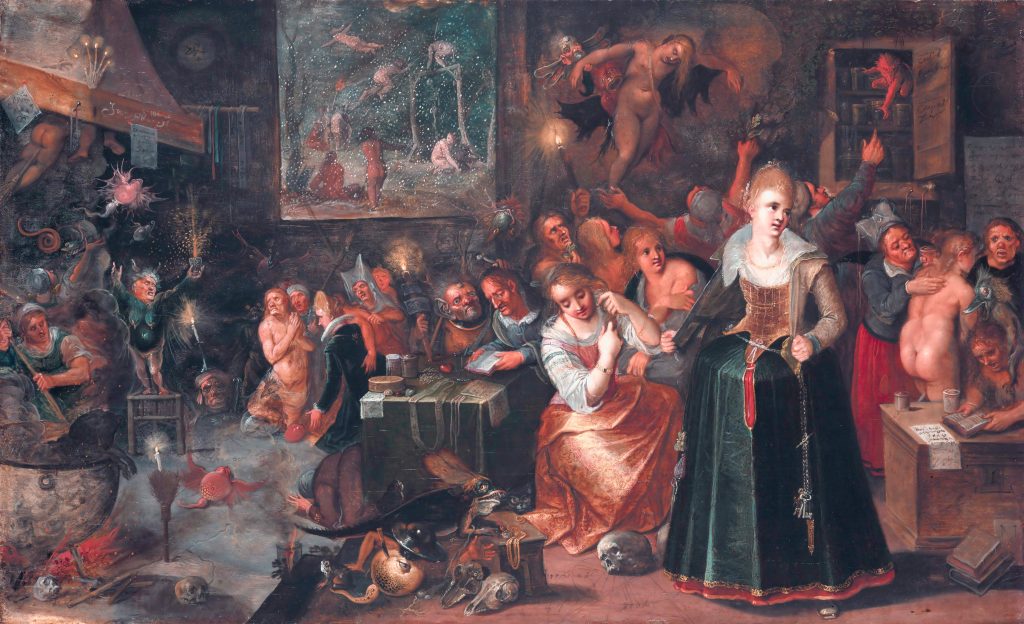
By Frans Francken the Younger - Staatsgalerie Neuburg, Public Domain.
On the right, there is a witch preparing a flying ointment.
On the left, a young witch is having a flying ointment applied on her naked body,
About the meaning of nudity
In Christian tradition, female nudity—and a female body in general—was regarded as a symbol of original sin. According to the thinking of the time, Eve was responsible for Adam’s sin not so much because of her own naivety toward the serpent, but because she tempted Adam to sin through her own nudity. Due to Thomas Aquinas’ adoption of Aristotelian philosophy in the late Middle Ages, this view was widely reflected in the art of the time. In scenes depicting original sin, Eve’s naked body is shown particularly clearly and dominates the scene.
Because of the actions of the Catholic Church, female body began to be perceived as something repulsive. Consequently, in medieval societies women were expected to be covered and modest, not exuding sexuality or nudity. Thus, naked women began to be regarded as heretics, harlots, and sinners. They were seen as witches, associated with sin, temptation and Eve.
The nudity of witches also relates to their connection with demons, Satan and impure forces which were likewise sexualized (which was, of course, a sign that they were evil). This means that they stand in opposition to God, highlighting the contrast with the accepted standard of the modest and asexual woman of that era.
Interestingly, even outside European culture, nudity is associated with witches—in African traditions, there are many rituals in which sorcerers are required to be naked. There, however, nudity carries a different connotation—it is not considered impure but signifies the contrast between ordinary people and sorcerers, who hold a high position within the tribe.
Bulgakov thus plays with the traditional image of the witch, portraying Margarita as naked, yet at the same time a highly moral woman in the Christian sense and in a monogamous and modest relationship with the Master. Margarita is connected to the Master spiritually, not physically. They aren't together to satisfy any erotic need - they spend their dates analysing the Master's novel, developing each other intellectually. That's just a kind of love that the Church would find godly. Furthermore, Margarita represents the biblical ideal of woman who sacriface everything for the beloved.
Thus, the Bulgakov's portrayal of the witches is in fact a mockery of the traditional image of a witch, for whom nudity signifies perversion, bestiality, and impure intentions, contrasting it with Margarita who has a pure heart and pure thoughts.
About the meaning of senility
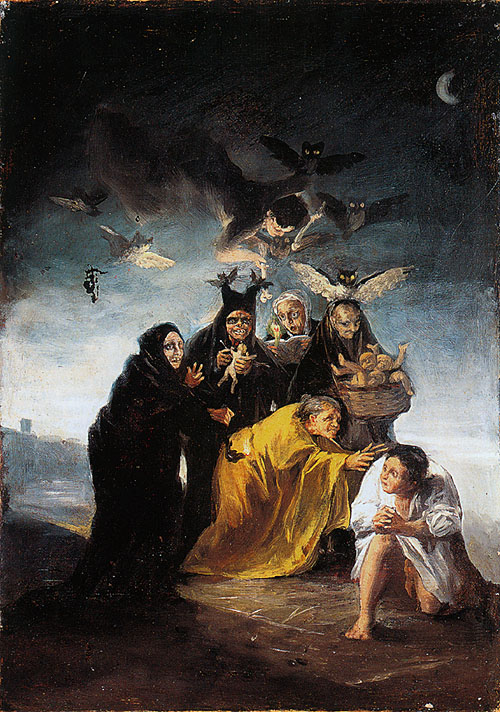
By Francisco Goya - Museo Lázaro Galdiano, Public Domain.
This is one of many portrayals of the old witches.
Azazello’s cream rejuvenates Margarita. She becomes younger, her skin becomes smooth and unlined again, her hair is shiny again. Margarita’s attitude also changes. She becomes joyful once again; she feels free and light-hearted.
It is against our modern image of a witch, an old, disgusting and abrasive woman. The image of the witch as an evil old woman has become ingrained in popular culture, but this was not always the case. Before Christianization, witches in Slavic countries were not necessarily old; their age was irrelevant—what mattered was their knowledge.
Christianization stripped old age of its positive connotations and made old women repulsive. Witches—wise women—were portrayed in the most disgusting manner. This is linked to the fear that independent women inspired in the Church and the fear of young women’s sexuality (which was associated with the devil, as I mentioned earlier). You may think that these two traits – licentiousness and oldness – are logically the opposites. However, according to many works of art from the witch hunts times, the old women were straightly connected to sexuality. Their physically disgusting age combined with the sexual activity created even more repulsive mix.
Thus, the Church was doing everything to disgust the society of the witches, making them not only promiscuous, but also old. And it all comes down to the present image of witch – hooked nose, warts, wrinkles. Completely misunderstood, that’s the image of the witch we think about today. That's so ironic how the independent and liberated women of the past were so repulsive according to the Catholic Church.
About the meaning of maternal instinct
When old age was depicted in any magical context before the Christianisation, it was as a sign of sacred knowledge, referring to the figure of the witch as a priestess in Slavic believes. It was also a mother figure and the archetype of the Tripple Goddess (Maiden–Mother–Crone) — represented in the forms of goddesses such as Mokosh, Isis, Ishtar, Danu and others, embodying wisdom.
For instance, Baba Yaga, the most popular witch in all Slavdom, was sometimes depicted as an old woman, but her age signified her magical powers (in a positive sense). It also signified Baba’s role as a mother — the mother of beasts and human children — which is a rather important element of the legends about her. As a Russian, Bulgakov draws heavily on this character, the most famous witch in Slavic folklore. For example, Margarita after her transformation to a witch meets a crying boy who is sung by Margarita to sleep. This portrayal of a maternal instinct stands in contrary to our modern understanding of a witch, however it is a reference to the old traditions.
The conclusion
In conclusion, Bulgakov created a witch thread grotesquely to deepen the message of critique of the Soviet system. By reversing every stereotype, such as the age and look of a witch, he emphasises what is the fate of the witches – the oppressed – in a totalitarian country. It truly is something so grotesque, to be able to be penalised – even by a death penalty – simply because you don’t fit the social standards. Just like the medieval witches.
Literature:
• Dangerous Bodies: Women's Nakedness and Theology by Wioleta Polinska (Journal of Feminist Studies in Religion: Vol. 16, No. 1 (Spring, 2000), pp. 45-62)
• Witches Now and Then: The Image of a Witch and Differences in the Perception of Female Witches During Sixteenth, Seventeenth Centuries and Nowadays by Antonina Kuras (Women's Space and Men's Space, ed. K. Ostalska, WUŁ, Łódź 2017)
• Design that Uses AI to Overturn Stereotypes: Make Witches Wicked Again by Xiaohan Feng and Makoto Murakami (International Journal of Artificial Intelligence & Applications, March 2023)
• The Problem of Mysteriousness of Baba Yaga Character in Religious Mythology by Evgenia V. Ivanova


[…] #2 The Master and Margarita by Michail Bulgakov […]