Is 'Wicked' worth reading?
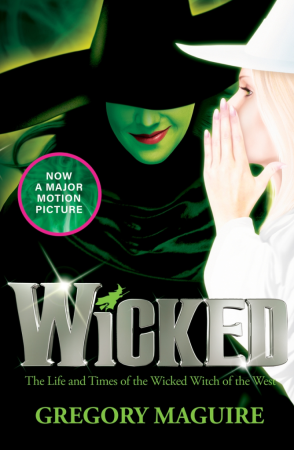
I love reinterpreting already-existing stories, creating alternative versions of classic themes. I particularly enjoy such recycling of fairy tales and legends—stories that have been part of culture for centuries. And when the author tries to explain the actions of the villains in the fairy tale, I read with special interest. I'm intrigued by how the creator explains why a given character ended up as a villain, why they strayed from the path of light. The same character is often portrayed in many such works, each time gaining a different back story, and thus a different explanation for their actions.
I Love Fairy-Tales Retellings
My favorite TV show, 'Once Upon a Time' (directed by Adam Horowitz) partly deals with absolving villains from universal fairy tales, showing their motivation and past. The Wicked Witch of the West, Zelena (one of my favorite characters in the universe), is portrayed as a complex victim of her mother's abandonment and lack of love. Green skin, somewhat her attribute, is not given to her forever and always. This trait only appears because of Zelena's jealousy, and it's a measure of how much she hates herself. Gregory Maguire, on the other hand, presents the Wicked Witch of the West from a different perspective than OUaT, and a musical and film created based on his book show the villan of Oz in an even different way. The book is completely different from the stage and film versions; it is a million times darker and more brutal.
I'll be honest, I have very mixed feelings about the book... again. I was very excited to read it, especially after seeing 'Wicked: For Good' at the cinema, but I can't decide whether and how successfully Maguire met my expectations. Therefore, there was a long, one-week break in posting. 'Wicked' covers a wide range of topics, from reflections on the nature of good and evil, ethical, religious, and political discussions. At the same time, it's not weighed down by excessive seriousness and the stiffness that comes with it. 'Wicked' is very pleasant to read, and Oz's descriptions through the narrative took me right to the land itself, where I walked through the magical land with the characters.
Analysis of Elphaba
Maguire tells the story of Ephlaba, the main character of his novel, a figure who wavers on the edge of morality, ambiguously good or bad. Elphaba, although seen as the villain of the original 'Wizard of Oz', cannot be called a villain by me. I also can't call her a heroin. I look at her more as a victim of fate that befell Elphaba, a victim of the wicked spirits of Oz.
Her whole life has been a string of misfortunes and disappointments, and every chance for happiness is inevitably lost. Innocent years in Shiz, the opportunity to find love with Fijero in Emerald City, idyllic moments spent in Kiama Ko with Sarima and her family - Elfaba cannot have it all. The world just won't let her. It's not some specific evil spirit - just bad luck. If Maguire wants to show something through 'Wicked', it's that good and evil are only conventional, artificial concepts.
This is demonstrated by the entire character of Elphaba - never clearly qualifying for any of these categories, yet existing in the world. There is no clear boundary beyond which Elphaba transforms from a young idealist and rebel into the bitter witch that Oz has declared evil. She's probably suffered too many losses and traumas: the death of her lover, her friend, her sister... Elphaba undergoes an unnoticeable transformation that culminates in the death of the witch at the hands of a child.
From a woman who tragically contributed to the death of her lover, from a woman desperately seeking forgiveness and to silence her conscience, Elphaba transforms into a woman blinded by an obsession with Dorothy. This is the moment when she is overcome with a desire for revenge for the lost happy ending or the emotion assigned to villains. Like Madame Morrible, Dorothy is a person Elphaba sees as a personification of the reasons for her failures. When a witch commits murder, it is a turning point, after which the witch irrevocably forfeits her chance for peace. Elphaba is thus a very ambiguous character, and her morality is blurred, she is the embodiment of the strangeness of Oz. This land is itself synonymous with otherness when viewed from the perspective of someone from the Other World, that is, us, people from Earth.
Elphaba, on the other hand, is an outcast in the world of the outcasts of normality - she's stranger than strangeness. With her green skin, she is a symbol of everything that is excluded in the world, and her sad fate shows what tragedy is associated with all discrimination. It depends on the interpretation whether Maguire writes 'Wicked' as an idealist, believing that with his book he can influence exclusion in the world, or rather only as an illustrator with his words of the terrible situation of human tolerance. I lean more towards the second option.
Analysis of Nessarosa
'Wicked' is full of ambiguous characters, and one of my favorites is Nessarose, the younger sister of Elphaba, the Wicked Witch of the East. She is the opposite of Elphaba. Although she is also an outcast from society due to her disability, Nessarose is not compared to a demon like her older sister. On the contrary, Nessarose is spoiled and loved by everyone for most of her life. It is only after her death that this changes dramatically. In contrast to her sister, Elphaba sees a monster in herself, her opinion of herself matches her reputation among the people.
Nessarose, on the other hand, sees herself as a holy martyr of her disability, although in reality she is possessed by religious fanaticism. I very much regret that the theme of Nessarose's sick obsession with faith was not included in the musical, but in the adaptations of 'Wicked' I appreciate the addition of the motif of Nessarose's disturbing way of loving. The character's love for Boq is very twisted and dangerous, which adds another layer of darkness to her character.
For that's the word that best describes Nessarose's character - darkness. She is one of the most 'wicked' characters in the entire novel, and her wickedness largely stems from the self-admiration and conviction of her own goodness that Nessaroza displays.
For years as a teenager, she actually manages to convince people of her advantages. But when Nessaroza, as a grown woman, takes over the position of the Eminent of Munchkinland after her great-grandfather and becomes a tyrant to the point that even Frox, who is infatuated with his daughter, begins to fear her.
'Wicked', as I've said, is a book of the broad specturm of topics. Maguire in an interesting way refers to the issue of religion - basically, he neither solves it nor takes a stance, but rather transfers the earthly reality of faith to Oz. It's interesting that although the author is writing a fantasy book, he is actually using a purely realistic style, with a journalistic touch, to convey the realities of our world.
The same pattern is evident in the political and anti-totalitarian themes, where Maguire repeats dystopian patterns, showing present or historical dictatorships in a very faithful way. Similarly with the issues of racism and other types of intolerance. I find this method of world-building intriguing because the author of Wicked doesn't really create anything new, but rather writes a grand metaphor of Earth happening in Oz.
All these elements make 'Wicked' an interesting piece, but I consider the characters of the sisters, created in a very ambiguous and deep way, to be its greatest asset. Additionally, I am impressed by the darkness of the book, which is on a completely different scale than in the musical adaptation. The stage and film versions are charming, especially with their happy endings. The original story creates an incredible contrast to them, and the level of difference can only be seen after reading all the versions of 'Wicked'.
However, I still don't think that movies and plays are inferior, just different. Although they lack the depth of the book, I regret that Maguire didn't come up with the idea of representing the characters of the Scarecrow, the Tin Man, and the Cowardly Lion in this way first. I think the musical did a great job of solving the problem of those characters who are just uninteresting and secondary in the book.
The book version is therefore an option for adult readers, incomparably more mature than the adaptation, although it lacks some interesting elements.
Cover image © Harper Collins. Used with permission.
[…] #3 Wicked: The Life and Times of the Wicked Witch of the West […]
[…] Zelena, as an iconic, but tragic character of ‘Once Upon a Time’, is one of the most complex characters in the show. And if there is an equally good portrayal of the Wicked Witch of the West from the original ‘Wizard of Oz’, it is the novel ‘Wicked’ by Gregory Maguire I once review. […]