'Babel' by R.F. Kuang: the Analysis of the Formal Aspects and Review
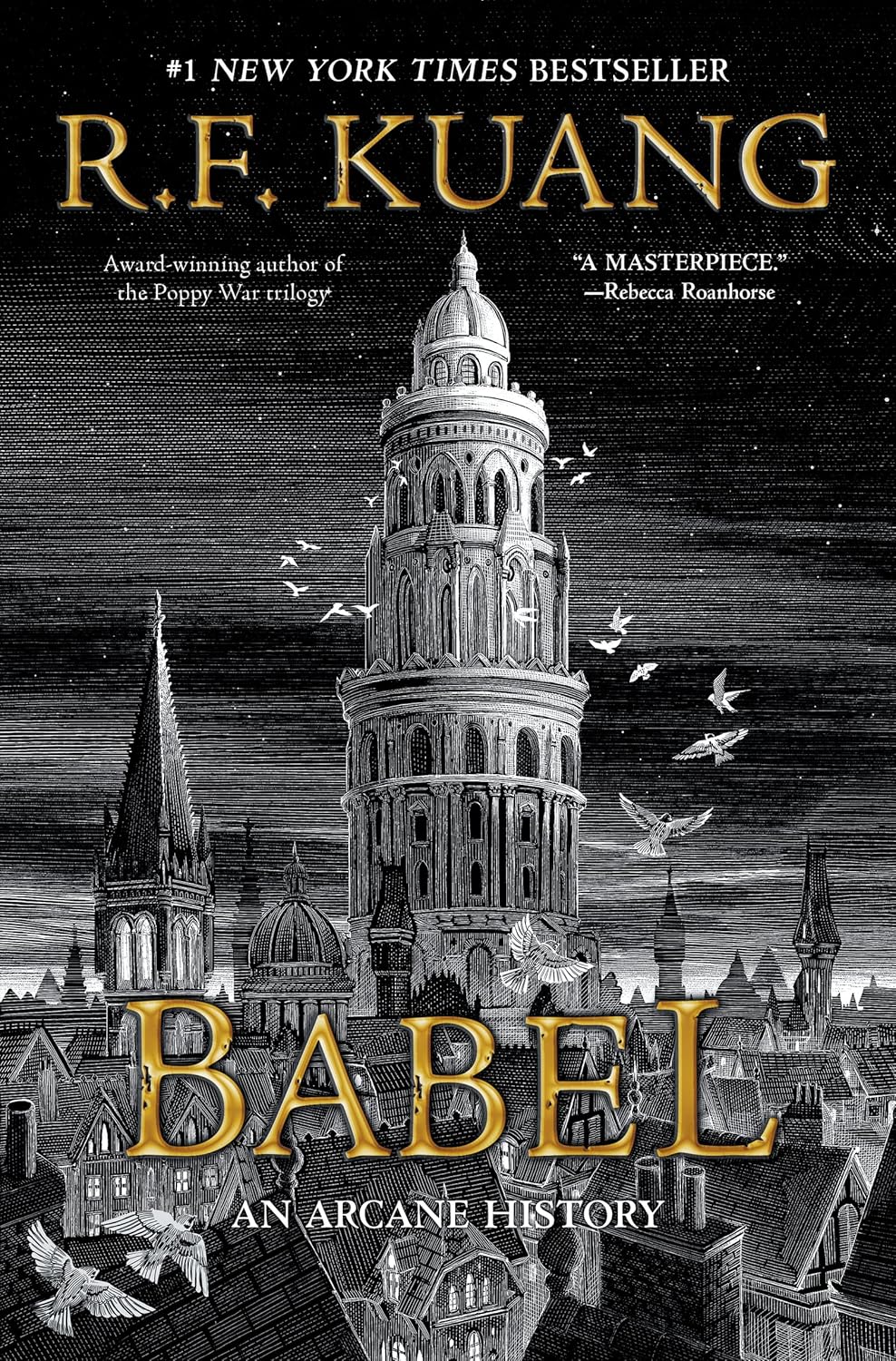
Bitter story about colonialism and its nature being the destruction of the foreign. About the consequences of the imperialist past of the West that are still current.
These topics of 'Babel, or the Necessity of Violence' by R.F. Kuang aren't just written directly, but also captured in the formal aspect of 'Babel'. This review will be mostly a literary analysis of 'Babel', what is - I believe - valid to understand the key of 'Babel'.
What is 'Babel' by R.F. Kuang About?
‘Babel’ is a story of Robin, a half-Chinese survivor from a plague in Canton. Robin is found half-alive by a white British scientist, Professor Lovell, and saved from a death by a magical silver bar. Lovell proposes Robin a simple choice – the boy may travel with him to Great Britain and study in the Oxford University or live in China in the famine and plague. Lovell takes Robin to England and brings him up in his country house. Robin prepares for majoring in translation studies under the tutelage of Professor Lovell and eventually gets in the Translation Department of the Oxford University in the titular Babel Institute.
Babel, the pounding heart of the British Empire in its finest, is a place where the magic at the base of the Empire begins. The silver bars produced in Babel are fuel used in every aspect of the elite’s lives. The bars are created from the slight differences between similar words in languages and their creation is the mission of the translators of Babel.
In Oxford, Robin faces both wonderful and painful reality. He grows up with new friends – Ramy, Victoire and Letty – and studies with passion and curiosity. However, the university remains a deeply racist, misogynist and elitist place. Thus, Robin with his non-white and female classmates experience prejudices and hatred. In this harsh world of colonialism and imperialism, Robin comes across a man unbelievably similar to him and this event will change his perception of the simplest moral values.
About the formal aspect of 'Babel'
Meaning of the Title
First thing that you sense when reading ‘Babel’ is its sublimity. It was a similar feeling for me to reading ‘Shades of Magic’ - the book feels like it is a good book, well-written and all. However, ‘Shades of Magic’ didn’t affect me any deeper, I only could feel its greatness without any consequence for my reception of the books. But ‘Babel’, on the other hand, felt different for me – I feel the hype worth this book.
This sublimity is not only a consequence of the hard topics of ‘Babel’ - colonialism, racism, violence, the evil of human nature – but I believe it is also a matter of the form Rebecca Kuang has chosen for her work. ‘Babel’, telling about the academicism of the 19th century British Empire, is a novel stylised as a treatise. Matching the dark academia motif of ‘Babel’, Kuang writes a novel with a title itself that appears like the research paper.
Kuang uses characteristic long title (‘Babel, or The Necessity of Violence: An Arcane History of the Oxford Translators' Revolution’) that is often used in scientific papers, with all the complexity and polynomiality.
The Controversial Annotations
Kuang uses characteristic long title (‘Babel, or The Necessity of Violence: An Arcane History of the Oxford Translators' Revolution’) that is often used in scientific papers, with all the complexity and polynomiality. Furthermore, the multiple annotations that make some annoyed, emphasise the scientificity of ‘Babel’. For me, the usage of the notes so often was an obvious reference to the convention of ‘Babel’ as tractate.
And while I understand why they are so controversial among readers, I really think they are the quintessence of ‘Babel’ that is also a mockery of the academicism. For me, Kuang at every turn laughs at the over-intellectualised scientific reality of elitism and inflated egos.
How Fantasy is 'Babel'?
Another controversial formal aspect of ‘Babel’ is a poor use of the fantasy literary convention. ‘Babel’ by R.F. Kuang had been nominated to the Nebula Awards (basically the Oscars of the fantasy literature) and won as the Best Book of 2022. Some argue that ‘Babel’ isn’t fantasy enough, and I think I may agree with this statement.
The magic system of ‘Babel’ is indeed vague and for me, it doesn’t play the greatest role in the whole message of ‘Babel’. Yes, as I said, the silver bars are essential for the world-building of the alternative history of the British Empire. However, the historical fantasy wasn’t the goal of Kuang as far as I am concerned. She portrays the societal condition of the colonial and post-colonial world, thus the magic in ‘Babel’ is quite non-essential when it comes to the whole message and topic of the book. But I must admit that I appreciate the unique and creative magic system, founded on the translations.
Make sure to read also these analysis of the formal aspect of 'Babel' by R.F. Kuang:
• The Meta-Linguistic and Analytic Magick Concepts in R. F. Kuang's Babel A Formal Thesis by Hector Haralambous [Vakalo College of Art & Design]
• The Weaponisation of the Language of Oppression: Review of R. F. Kuang, Babel: Or the Necessity of Violence: An Arcane History of the Oxford Translators’ Revolution by Marie-Luise Kohlke [Swansea University]
Babel Cover image © Harper Voyager

[…] Read my first post about 'Babel' – the analysis of its formal aspect • and how it affect the R.F. Kuang's message • […]
[…] Read my post about romantasy genre • the necessity of romantasy • […]