Why 'Babel' By R.F. Kuang Is Still Important?
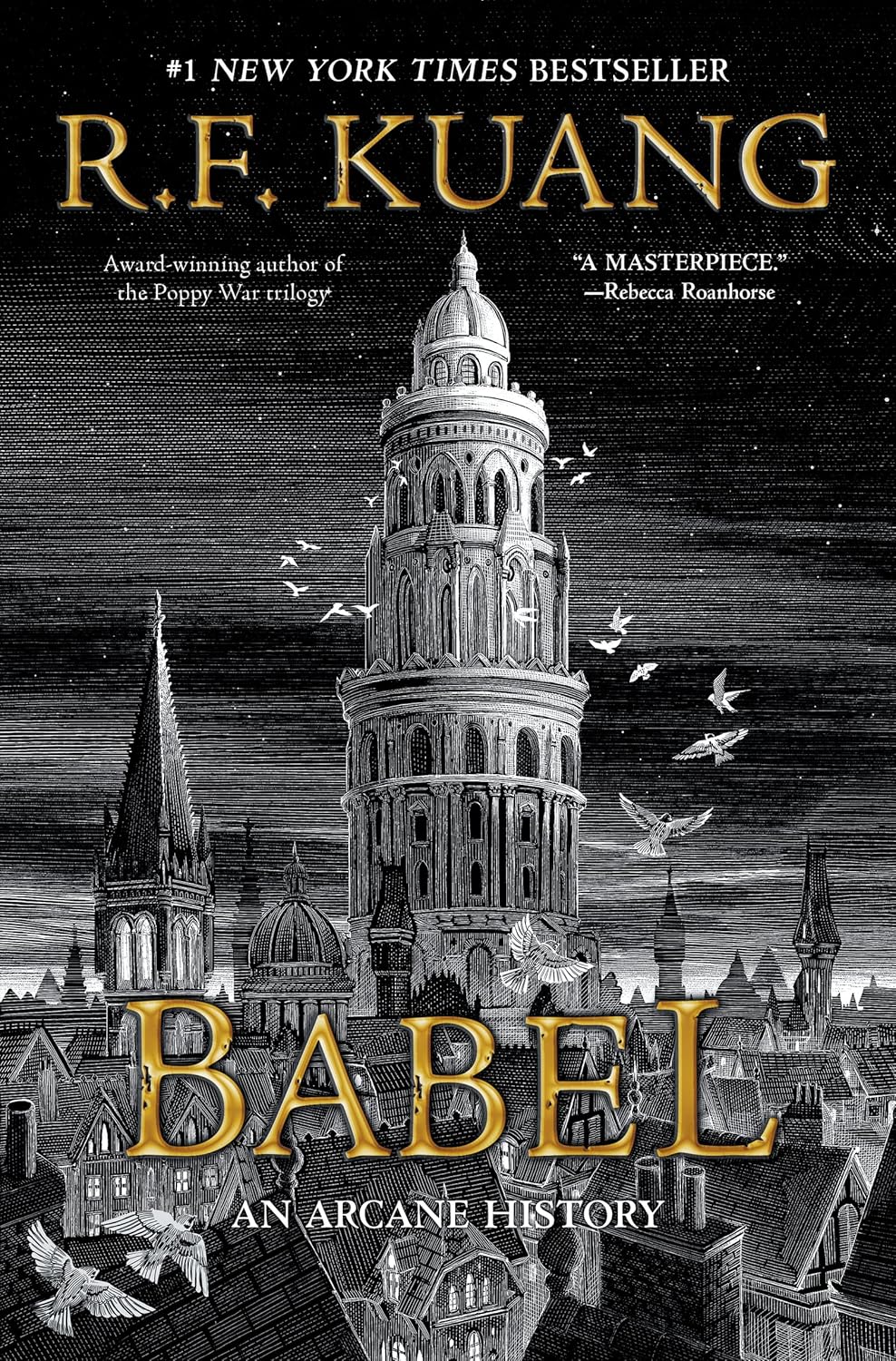
Adressing still current topics of discrimination against the people of colour and women, of wrongful conditions in colonial and post-colonial lands, 'Babel' by R.F. Kuang is a book historical only at the surface. Although 'Babel' is a historical/alternative history fantasy, a story with the fully imaginary Babel Institute of Translation, with the fully imaginary magic system, its problematics are in fact the condition of modern societies.
What is 'Babel' by R.F. Kuang About?
'Babel' is a story of Robin, a half-Chinese survivor from a plague in Canton. Robin is found half-alive by a white British scientist, Professor Lovell, and saved from a death by a magical silver bar. Lovell proposes Robin a simple choice – the boy may travel with him to Great Britain and study in the Oxford University or live in China in the famine and plague. Lovell takes Robin to England and brings him up in his country house. Robin prepares for majoring in translation studies under the tutelage of Professor Lovell and eventually gets in the Translation Department of the Oxford University in the titular Babel Institute.
Babel, the pounding heart of the British Empire in its finest, is a place where the magic at the base of the Empire begins. The silver bars produced in Babel are fuel used in every aspect of the elite’s lives. The bars are created from the slight differences between similar words in languages and their creation is the mission of the translators of Babel.
In Oxford, Robin faces both wonderful and painful reality. He grows up with new friends – Rami, Victoire and Letty – and studies with passion and curiosity. However, the university remains a deeply racist, misogynist and elitist place. Thus, Robin with his non-white and female classmates experience prejudices and hatred. In this harsh world of colonialism and imperialism, Robin comes across a man unbelievably similar to him and this event will change his perception of the simplest moral values.
A Little Disclaimer
Before I will say anything about the plot and the problematics of ‘Babel’, it is necessary for me to mark something important. That it is impossible for me to fully feel the emotional charge Kuang tries to convey. I am a white Polish woman, and when it comes to the topic of colonialism, I know I am not a person to feel personally entoiled in it.
My nation has never taken part in the colonialism. We haven’t been a victim nor an offender of these tragical experiences. My country didn’t even exist during the action of ‘Babel’. I don’t come from a culture with a colonial background. Thus, I do not feel like a pertinent person to judge the problematics of ‘Babel’ like an expert. Additionally, as a white person I have never experienced problems the people of colour live with. I am aware of the existence of white privilege and, again, I am not to judge the experiences of racism in ‘Babel’.
Racism in 'Babel' and Modern World
These are the reasons why I am not able to feel the real importance of ‘Babel’. However, it should be obvious for everyone that Rebecca Kuang accurately conveys the problems of both modern and the 19th century world. Racism, colonialism and all the evil was and is existing out there. The stories of Robin, Rami, Victorie, Anthony and other non-white students of Babel are painful reflection of still present brutal reality of the people of colour. Because it’s not like racism ended with the colonial era – it's still in our societies and cultures.
Feminist Content of 'Babel'
Additionally, I can relate with the Kuang’s portrayal of the females in academicism. As a studying woman, involved in the scientific world, I come across the gender prejudices and inequality in science. I agree with Rebecca and her judgement of the universities because – just like in the matter of colonialism – her statements are still current today.
Letty and Victorie experience similar things many women of science experience today - disdain, incomprehension, not enough representation. Some problems are thankfully a matter of the past, for example Letty and Victorie not being allowed to borrow books from the library without a male supervision. However, other are still current. Especially in the more conservative countries, like mine.
Analysis of Letty Price
Speaking of women in ‘Babel’, I think it’s time to discuss the character-building of Letty. She is one of Robin’s friends. But in contrary to Robin, Rami and Victorie, Letty is white and has always been privileged. And not only because of her skin colour, but also her family background. Letty’s father is an exalted British serviceman. Thus, Letty and her brother grew up without financial problems like others from the friend group.
Robin, Rami and Victorie were taken in custody of intelligentsia, but they never were treated like a part of the rich families. The best example is Robin and Professor Lovell’s abusive relationship. It all makes Letty a separate element of their friend group, unaware of the difficulties the oppressed face. Letty isn’t able to understand the matter of racism Robin, Rami and Victorie come across.
The Hermes Society
Eventually, the friend group gets involved in the activity of the Hermes Society. Its mission is to improve situation in the colonies; and Letty is the only one that doesn’t get the idea of weakening the British Empire. Letty claims that her non-white classmates and friends should be grateful to the Empire for getting a chance to live in luxury and academic success. She doesn’t understand that all the things Robin, Ramy and Victorie gained by moving to England – entitlement to food, health care, education, a roof over their head – are all basic human rights. And they shouldn’t feel gratitude for having just right to live a decent life.
The lack of understanding what the importance of the Hermes Society really is lead Letty to betray her friends. She causes the death of some of them. This act is the reason why some hate Letty for what she does. However, for me she isn’t fully guilty. In my opinion, she is more a puppet of the Empire than a villain herself.
How does the system affect an individual?
Letty Price and Gabi Braun
Letty lives in illusion of the perfect world, blinded by the British propaganda. And her actions don’t come from the inner evil, but more – from self-centred unshakable belief in the system. However, I feel like some readers can’t see that the real villain in this story is undoubtedly the colonial and oppressive system, not any individual. This reminds me of the case of Gabi Braun in ‘Attack on Titan’. She is also a character hated for her murder on a adored character. But not everyone understands that the real evil in both ‘Attack on Titan’ and ‘Babel’ is racist empire. Gabi, just like Letty, is sure that what she does is good because she is on the side of the good.
The most important aspect of 'Babel':
The Ultimate Cycle of Evil
As I said, both Hajime Isayama and R.F. Kuang create the empire of ultimate evil, that represent the infinite cycle of violence. The British Empire in ‘Babel’ is created by Kuang to let the reader sense the disgust from the slimy hatred and violence, the force that eventually possess everyone. Robin is the character that is changed the most during the plot because of this sticky violence, whose tentacles plaster to everyone despite their idealism. This is the Kuang’s way to show her ultimate message of ‘Babel’. That the evil of system and its blood-thirsty violence always hunts you down, even when you are a good person. And that you should do your best not to be victim of this cycle, just like Letty Price or Gabi Braun did.
Summary
Babel isn't an easy book to read. It forces you to reflect on every moral rule you have, on the system you live in. It isn’t the reading for pleasure. It is bloody and violent, showing the real conditions of oppression. But if you are not afraid to face the uncomfortable topics and you rather read about what really matter, don’t be afraid ‘Babel’. It may even change your perception of the world.
FAQ
Cover image © Harper Voyager


[…] Read my review post about 'Babel': Why is it So Important? • analysis of the plot • […]