House of Leaves:
Review and Analysis of the Labyrinth Symbolism
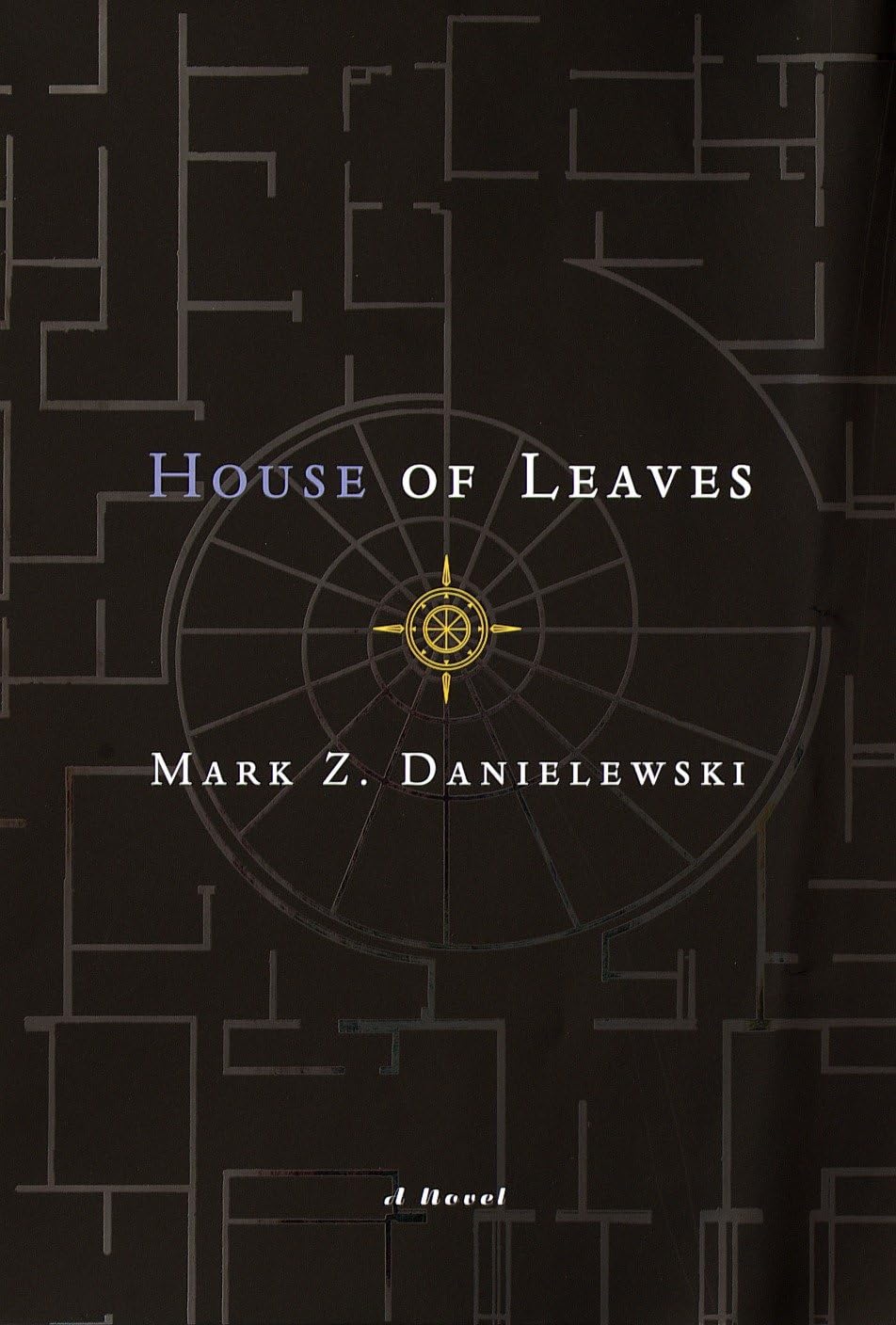
I love a good horror book but this one is nothing like any of this genre I've ever read. 'House of leaves' deserves a title of the crippiest novel of the year due to its unusual atmosphere and concept. 'House of leaves' is a horror/thriller book without a concrete antagonist or a specific evil forces. Despite it, I felt extremly uncomfortable reading this book. Furthermore, 'House of leaves' is rich in various metaphores or symbols and is a case in point of the postmodern represtenants of referring to antique.
In the Danielewski's book the trope of a labirynth is used, originated independently in many ancient culture fields. Also the form of 'House of leaves' is another intriguing element of a book with the usage of different fonds and other kinds of unusual text formatting.It all makes 'House of leaves' a challenging, unique and intelectual (or maybe pseudo-intelectual? I can't decide) novel that also supplies a reader with a thrill of discomposure.
What is 'House of Leaves' About?
'House of leaves' is an American novel about a titular house whose interior is larger than it may seem from the outside. This idea itself makes me shiver, not exactly from being afraid of the concept but just its unncanniness. The sence of unnaturalness is even deeper when a reader is becoming more and more immersed in the inner world of the book, whose story is surprisingly quite simple. After the famous photographer, Will Navidson, moved in to the new house with his family, he become obsessively fasicinated about the inadequacy with the building's dimentions.
Will and his friends discover that in the interior of the house exist a literal labyrinth, infinite and indefinite. It turns out to be a trap imprisoning people in a madness, like it does with Will, who become obsessed with coming back to the labyrinth again and again.
But not only does the structure exists, it also isn't permanent and logical - its structure changes all the time, tricking the characters to be trapped in the labyrinth longer and longer. The corridors may become by rotation longer and shorter or broaden and narrow itself, stairs may elongate or shorten and the roof may elevate or lower. It causes a both claustrophobic and agoraphobic feeling of a reader. In short, the titular house is itself the picture of literal madness.
The Labyrinth Symbolism
Danielewski uses in 'House of leaves' the ancient trope of a labyrinth. This kind of construction has been built or depicted by ancient cultures, such as Greek, Egyptian or Hindu ones. Surely, the most popular is Greek Labyrinth, legendary located on the Crete island. It was made by the mythical creator and architect, Daedalus, to imprison Minotaur - the son of a Cretan queen Pasiphaë and a bull. A god of seas, Poseidon, cursed the queen to fall in love with the bull and in the result she has given birth to the monstrum.
Minos, a king of Crete and Pasiphaë's husband, captured Minotaur in the Labyrinth. The king ordered Athenian people to supply Minotaur regularly with 14 teenagers: 7 girls and 7 boys, to be eaten by the creature. Finally, a famous heros Theseus with princess Ariadna's help, managed to find Minotaur in the Labyrinth, kill the beast and lastly go out of the structure alive. Danielewski consciously references to Cretan Labyrinth and even mentiones it during the narrative, including a case of Minotaur.
Even More Labyrinth Symbolism
Labyrinth is a meaningful and polisemic symbol since the antique. Firstly, it may mean 'an underground world of dead, an inferno, a land of darkness', which perfectly coresponds with 'House of leaves'. The labyrinth is definitly a place of evil, despite this evil not being concrete or encarnalised. It bring the visitors madness - and it's the worst thing a person can receive. A labyrinth is also the symbol of 'the vegetative world, an intericacy of roots and branches, the forest's thicket'. It also matches the 'House of leaves', concretly - the title.
Conclusion
'House of Leaves' is the most creepy book that is creepy not because of simple horror motives, like monsters, but the sense of the unnameable danger itself. Alongside with a deep symbolism, it make 'House of Leaves' by Mark Z. Danielewski absolutely unforgettable book, in my opinion fully worth the cult that the novel is an object of.
Cover image © Pantheon