Symbolism in 'Rouge' by Mona Awad
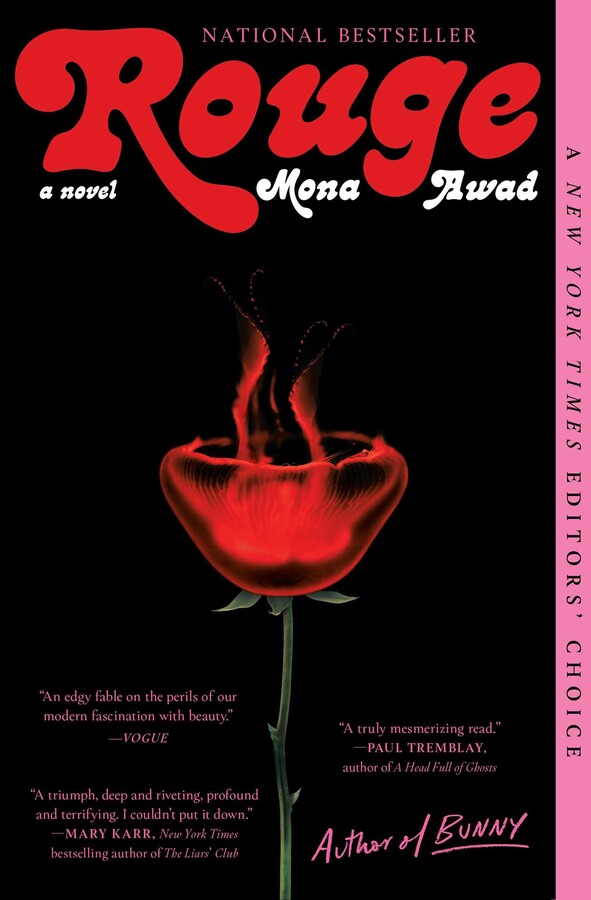
'Rouge' by Mona Awad is a novel rich in symbolism. The surrealistic elements only at first sight are illogical - yet, they have a lot of sense considering their hidden meaning. Mona Awad has written 'Rouge' inspired by various myths and fairy tales from around the world, combining them in a mix of complexity.
Jellyfish symbolism
Jellyfish is a symbol of the titular secret group and is even depicted in the book cover of 'Rouge'. These animals also serve as a receptacle of a person's memories and traumas whose collecting was a real goal of Rouge. Jellyfish are a symbol of beauty and grace which has origin in their unusual jelly-like structure and jellyfish's hypnotising way as it consequence. Also the bioluminescence (the natural process of a light production by organism) that is a trait of most of jellyfish is a propable reason of their symbolism as a sea animal equated with beauty.
So, no wonder Mona Awad has chosen jellyfish to represent Rouge's obsession on beauty. What is more interesting considering the plot of 'Rouge', jellyfish are also a symbol of immorality. Some jellyfish are able to regenerate themself literally infinitively, coming back to the life stage of a polyp and then growing up once again to known everyone Medusa stage (adult jellyfish).
It's valid considering the plot of 'Rouge' and the dream of every-lasting beauty and immorality that has been a aim of the members of Rouge. Moreover, jellyfish are also are wanting in brain and heart which makes them a perfect choice to represent the members of Rouge that are shorn of mind and mental stability (brain) and soul (heart) as a consequence of being in Rouge.
Mirror symbolism
Mirrors, especially the broken ones, are an instinctively associated in my mind with The Devil's Mirror from 'The Snow Queen', a Danish fairy tale by Hans Christian Andersen. Its splinters which has been located in people's eyes has a power to manipulate a way they interprete the world and its residents. Everything becomes ugly and bad seen by The Devil's Mirror and that's how the world and herself looks for Belle while she's obsessed about perfect beauty.
I personally believe that Rouge as a organisation is a secondary issue in the novel and the main topic is the story of Belle itself and discovering her dark and secret past. A mirror is a core symbol of her story while it is a way of Seth haunting Belle in her childhood. Mirrors are obviously a symbol of truth and showing the real side of world. Thus, the real identity of Seth, a being that visited Belle when she was a little girl, is actually Belle herself and Seth is just the personification of her dark side.
Furthermore, in my native Poland and other Slavic lands, mirrors are considered a gate to the spiritual worlds. That's why a superstition of not placing a mirror facing a bed exist in Slavdom (fun fact). It explains why a mirror is an entry for Seth to real world.
Broken Mirror Symbolism
Now I want to present you my theory what the broken mirrors that Belle's mother, Noelle, was so motivated to break, may mean. Considering she knew about Seth visiting her daughter, Noelle wanted to somehow destroy his gate to meet with Belle. But in most superstitions of the whole world, a broken mirror is a sign of the upcoming misery. The same in Slavic ones that has been a propable inspiration for Mona. In our tradition, breaking a mirror ironically doesn't stop spirits from entering human world and even may make it more likely.
So, I think that Noelle only opened a gate for Seth again and again. Maybe that's why he was able to materialised in a human form as a Noelle's lover and then he meets with Belle in California when she's an adult. Maybe that's why mirrors break even when Noelle is dead but Belle embraces her mother's soul after joining Rouge and starting their therapies.

Egyptian symbolism
The usage of this concrete Egyptian symbol is a valid to understand who is the real anthagonist of 'Rouge'. Obviously, Belle is half-Egyptian but it's not the only Egyptian reference in the whole 'Rouge'.
The most important detail is the name of Seth - it's an alternative spelling (that comes from Greek sources) of the name Set, the Egyptian god of chaos and generally incarnation of evil. Set is the god responsible for death of Osiris, the Egyptian god of afterlife. But did you know that the nemesis and the opposite of Set is Horus whose Eye ornaments Belle's bracelet?
Horus is the god of protection, associated with pharaoh. His sign is The Eye of Horus, the widely known symbol of the left wedjat -eye. The Eye of Horus is a symbol of protection and luck. Althought there are various versions of what was the origin of this symbol, every one tells that Set was the one to purge Horus of his eye. Then, one of the other gods like Thoth or Hathor returns the eye to Horus. In 'Rouge', The Eye of Horus is a symbol of Belle's heritage and her connections with her father. It's a symbol of Belle's dad who protects her from the afterlife. When Belle agreed to help Seth with his plan of killing Noelle as a little girl, she lost her bracelet which is a symbol of the evil that possessed her.
The Book Cover Symbolism
The colour related to Set is red, as a symbol of desert and drought (the evil lands for the ancient Egyptians). Thus the red jellyfish, the Rouge's symbol, gains a deeper meaning. On the other hand, black is a colour associated with good as it is a symbol feracity and irrigating, especially important and worshipped in the desert Egypt. So, the cover image of 'Rouge' an as the combination of the red jellyfish (representing Set and evil) and the black background is a genious and deeply symbolic design.
As you can see, 'Rouge' by Mona Awad isn't only a simple novel about the obssession over lasting beauty - it's a symbolic journey through a mythology from all over the world.
Cover image © Bloomsbury Publishing House. Used with permission.
[…] Read my interpretation of other Mona Awad's surrealistic novel, 'Rouge' here. […]
[…] Read my full symbolic analysis of 'Rouge' here. […]